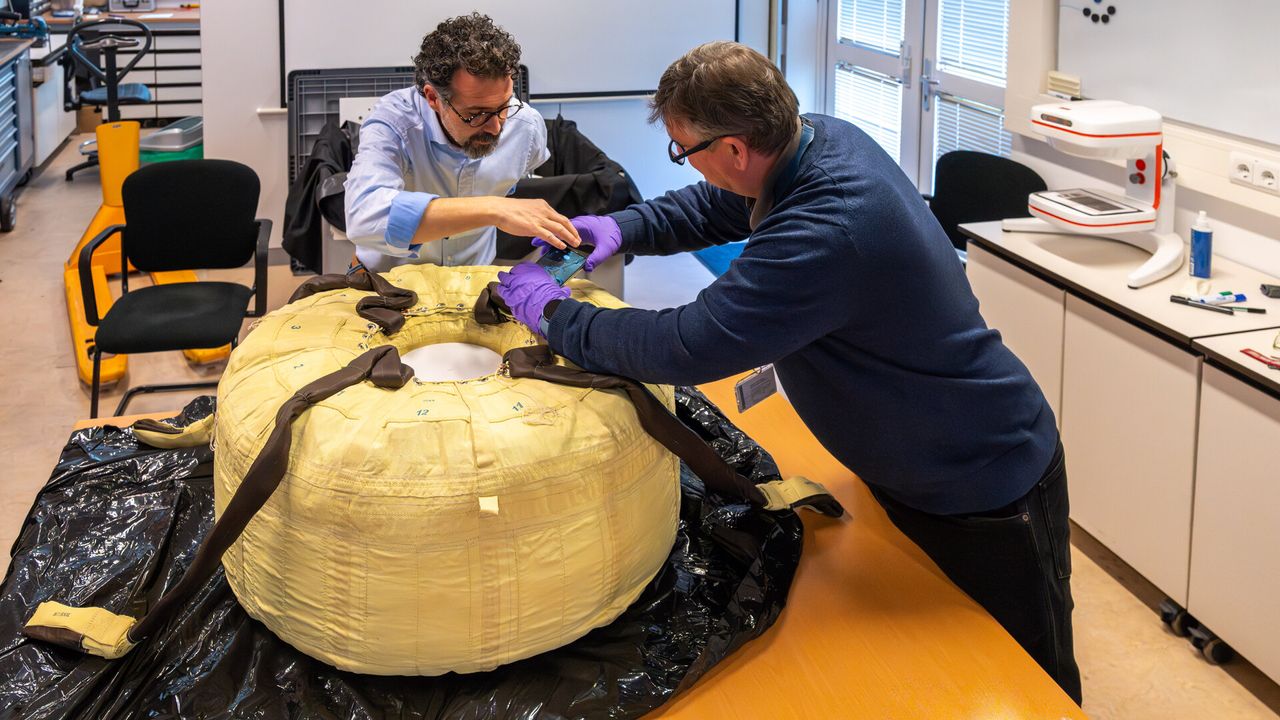
When you first look at the image above, you might think it’s a strange, oversized donut or a piece of avant-garde sculpture. But that peculiar, ring-shaped bag actually holds a massive parachute destined for the Red Planet. As space exploration pushes further, every component must be engineered to perfection—and this parachute is no exception. Here are five fascinating facts that reveal the science, scale, and stakes behind this remarkable piece of hardware.
1. The Donut Bag: A Genius Packaging Trick
The first thing that catches your eye is the bag’s unconventional shape—a thick torus that looks nothing like a typical parachute container. In reality, this “donut” is a custom-designed deployment bag. Its circular form allows the massive parachute to be folded and packed symmetrically, ensuring it unfurls evenly when released. This design minimizes tangling and reduces stress on the fabric during the high-speed inflation process. Think of it as the ultimate origami: engineers must fold hundreds of square meters of advanced synthetic fiber into a compact, aerodynamic package that can survive violent deployment forces. The bag itself is made of lightweight but durable materials, and its donut shape isn’t just for looks—it’s a critical part of the parachute system’s reliability. Every wrinkle and crease is calculated to guarantee a flawless opening, hundreds of millions of kilometers away from Earth.
2. Destination: Mars—Where Thin Air Is the Enemy
This parachute isn’t designed for Earth; it’s built to operate in the thin, cold atmosphere of Mars, which is only about 1% as dense as our own. That poses a huge challenge: a parachute needs enough air resistance to slow a fast-moving spacecraft, but on Mars the air is so sparse that conventional parachutes would be nearly useless. Engineers compensate by making the parachute enormous—some of the largest ever built for planetary entry. The donut bag seen in this photo is a key part of the system being tested for NASA’s next-generation Mars landers. Without a parachute this size, the spacecraft would crash into the surface at hundreds of kilometers per hour. The Mars atmosphere is just thick enough to generate drag, but only if the canopy is massive and opens at precisely the right moment. That’s why every test, including this photo session, is a step toward ensuring humans and rovers can land safely on the Red Planet.
3. Massive Scale: Bigger Than a House
To give you an idea of the parachute’s size: when fully inflated, it would cover a full-sized residential house. The packed donut bag itself is about two meters across, but the fabric inside it stretches to a diameter of over 30 meters. That’s roughly the wingspan of a Boeing 737. The entire system—canopy, suspension lines, and deployment bag—weighs hundreds of kilograms. But weight is critical on any space mission; every gram must be justified. The parachute uses ultralight, high-tenacity fibers (similar to Kevlar or Vectran) that can survive extreme temperatures and loads. The sewing alone involves kilometers of thread and hundreds of hours of labor. When you look at the donut bag, remember that inside is folded a structure that could, if spread out, blanket a small field. That scale is necessary because on Mars, you need all the drag you can get.
4. A Torture Test in the Skies Over Earth
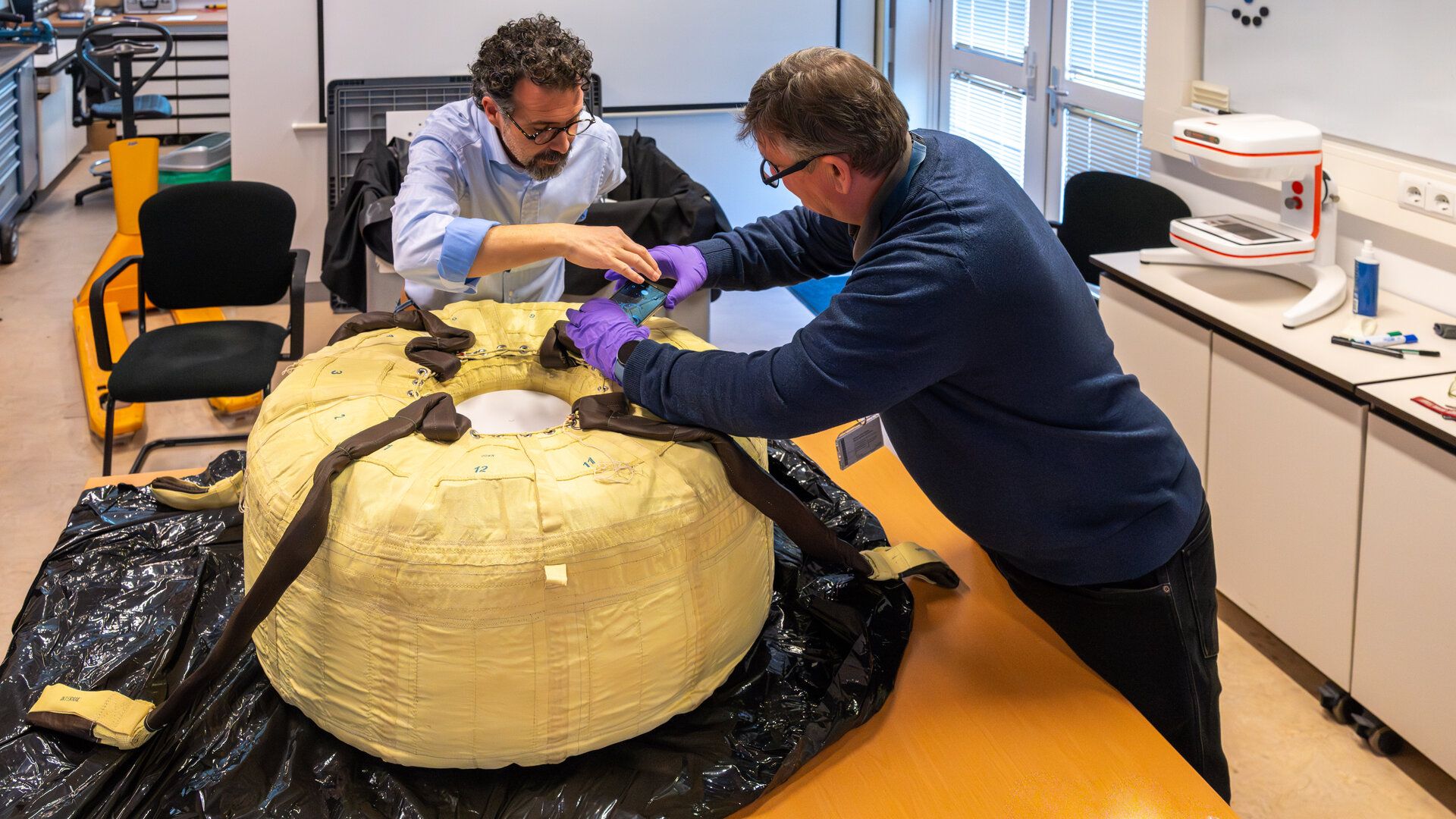
Before any parachute flies to Mars, it undergoes brutal testing right here on Earth. The photo you see is part of a “drop test” campaign. A rocket or high-altitude balloon lifts the donut-shaped bag and its contents to extreme altitudes—often over 30 kilometers—where the air density roughly mimics the Martian atmosphere. The package is then released, and the parachute deploys at supersonic speeds. Instrumentation records every jolt, tear, and oscillation. The test is so violent that parachutes sometimes rip apart. That’s part of the process: finding the weak points so they can be reinforced. The donut bag in the image survived to show us exactly how it behaves under stress. These tests are critical because a parachute failure on Mars means a billion-dollar mission ends in a crater. Every wrinkle in that bag tells a story of engineering resilience.
5. Why This Matters: The Gateway to Human Exploration
This donut-shaped parachute isn’t just a curiosity; it’s a linchpin for future Mars missions. As we aim to send larger rovers—and eventually humans—we need ever bigger and more reliable deceleration systems. Supersonic parachutes like this one are the only way to slow a heavy payload from orbital velocity to landing speed within the thin Martian air. The technology being refined here will be used in the Mars Sample Return campaign, which aims to bring Martian rocks back to Earth, and eventually in crewed landers. Each successful test brings us one step closer to boots on the ground. So next time you see a funny-looking donut in space news, remember: it’s not a pastry—it’s a promise that one day we’ll walk on Mars. Back to the top
Conclusion
The next time you glance at a photo of a donut-shaped bag floating in a test chamber, you’ll know it’s far more than an oddity. It represents the cutting edge of planetary entry engineering—a carefully folded gateway to another world. From its ingenious packaging to its life-or-death role in Mars landings, this parachute system embodies the creativity and precision that define modern space exploration. As missions grow bolder, these doughnut-like deployment bags will keep proving that sometimes the best solutions come in round packages.