In a remarkable step forward, researchers have demonstrated that ordinary sunlight can be used to generate quantum-linked photon pairs—a feat previously thought to require sophisticated laboratory lasers. By developing a sun-tracking system that channels sunlight through optical fiber into a special crystal, they created strongly correlated particles that enable ghost imaging, a method where images are reconstructed indirectly through quantum correlations. The sunlight-powered setup achieved image quality close to traditional laser systems, successfully recreating detailed images like a ghost face. This breakthrough opens the door to more accessible quantum imaging technologies, potentially revolutionizing fields from medical diagnostics to remote sensing.
What is quantum ghost imaging and why is it significant?
Quantum ghost imaging is a technique where an image of an object is formed not by directly detecting light that has passed through or reflected off the object, but by using quantum correlations between pairs of photons. One photon interacts with the object and is detected by a simple bucket detector (which only records the presence or absence of light), while its entangled partner is detected by a high-resolution camera but never interacts with the object. Through correlation analysis, an image emerges “as if by magic,” hence the name “ghost imaging.” Its significance lies in its potential for imaging in low-light conditions or through scattering media, and the new study shows it can be powered by sunlight, making the technology more practical and accessible outside specialized labs.
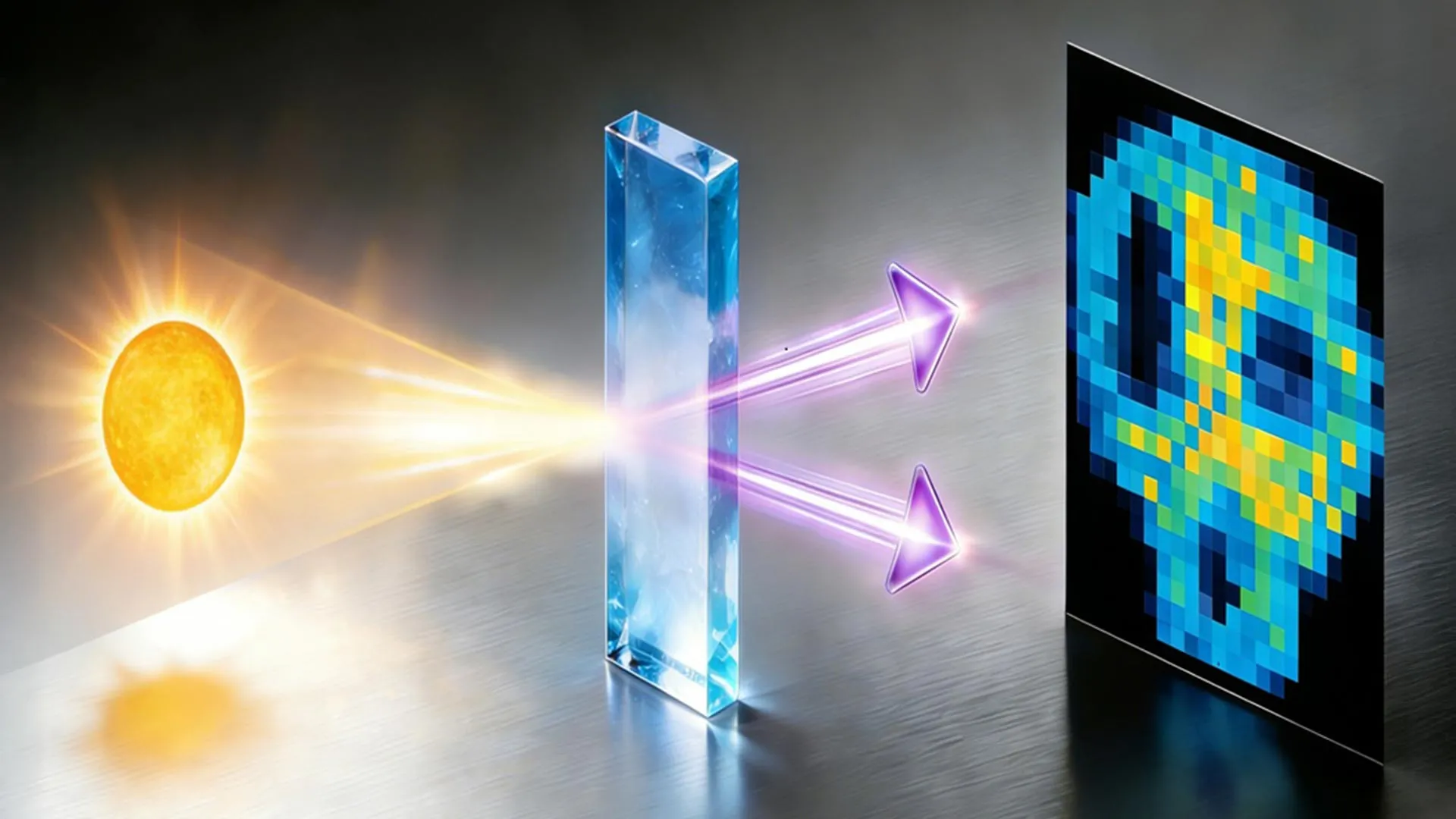
How did scientists manage to use sunlight to create quantum-linked photon pairs?
The team built a compact sun-tracking system that continuously follows the sun and funnels sunlight into an optical fiber. This fiber delivers the concentrated sunlight to a nonlinear crystal, where the natural process of spontaneous parametric down-conversion (SPDC) occurs. In SPDC, a single high-energy photon from the sunlight splits into two lower-energy photons that are quantum-entangled. Previous attempts to achieve SPDC with sunlight were unsuccessful because the process is extremely inefficient—typically requiring intense laser light. By maximizing light collection through the sun tracker and optimizing fiber coupling, they finally generated enough correlated photon pairs for ghost imaging, a feat long thought impossible with such a weak source.
How does the image quality from sunlight compare to that from laser-based systems?
Surprisingly, the sunlight-powered ghost imaging setup produced image quality nearly equal to that of conventional laser-based systems. The researchers were able to reconstruct detailed images, including a silhouette resembling a ghost face, with comparable contrast and resolution. While the imaging speed is slower due to the lower flux of photon pairs from sunlight, the final image fidelity is remarkably similar. This suggests that for many applications, natural sunlight could substitute for expensive and bulky lasers, reducing costs and complexity. The trade-off is mainly in acquisition time: the sunlight system requires longer exposure to accumulate enough correlated events, but the image quality once processed is on par with laser-driven counterparts.
What challenges did researchers overcome in this experiment?
The primary challenge was the extremely low efficiency of spontaneous parametric down-conversion under sunlight conditions. SPDC typically requires intense, coherent laser light to generate entangled photon pairs in any practical quantity. Sunlight, though abundant, is broadband and incoherent, making it a very poor source for such nonlinear optical processes. The team had to design a sun-tracking system that precisely followed the sun’s path to continuously gather and focus light into a single-mode optical fiber. They also had to filter the sunlight carefully to select the wavelength bands that work best with their crystal, and they needed highly sensitive detectors to count the few correlated photons that were produced. Overcoming these hurdles demonstrates a significant engineering achievement that brings quantum optics closer to everyday applications.
What are the possible future applications of sunlight-powered ghost imaging?
This breakthrough could make ghost imaging technology far more practical and affordable. Potential applications include imaging in low-light or remote environments where lasers are not feasible, such as aerial surveillance using only natural light, underwater imaging with scattered sunlight, or medical imaging where laser exposure may be harmful. Simplified setups could enable portable ghost imaging devices for field use, from archaeological surveys to environmental monitoring. Moreover, using sunlight instead of lasers reduces the complexity and cost of quantum imaging systems, potentially democratizing access to advanced imaging techniques. The research also opens avenues for using other natural light sources, like moonlight, further expanding the possibilities for quantum imaging outside the laboratory.
How does the quantum correlation process work in this sunlight setup?
In the sunlight-powered version, the key step remains the same as in laser-based ghost imaging: spontaneous parametric down-conversion (SPDC). Inside the nonlinear crystal, an incoming photon from sunlight (after being filtered and focused through the fiber) has a small probability of splitting into two entangled daughter photons. These twin photons are strongly correlated in various properties, such as polarization and momentum. One photon is directed to illuminate the target object and then collected by a bucket detector that simply registers whether it arrived or not. The other photon (the “idler”) goes directly to a multichannel camera. Even though the idler never touches the object, by correlating the bucket detector signals with camera pixels, the system reconstructs an image of the object. The use of sunlight adds natural randomness and broadband nature, but the core quantum correlation mechanism is robust enough to yield ghost images.
What was the most impressive result demonstrated in the study?
The most visually striking result was the reconstruction of a “ghost face” image using only sunlight. The researchers used a patterned metallic mask shaped like a stylized face as the target object. The final ghost image, built from correlating thousands of photon pairs, clearly showed the face’s outline and features—comparable to images produced with a conventional laser setup. This demonstration proved that despite the immense weakness of the sunlight source and the inefficiency of SPDC, the quantum correlation signal could be extracted from the noise and integrated into a clear image. Moreover, the team showed that the image quality improved with longer acquisition times, aligning with theoretical predictions and validating the feasibility of sunlight-based ghost imaging for real-world applications.