Introduction: Beyond Ingenuity
Just over three years after NASA's Ingenuity helicopter completed its historic Mars mission, engineers at the Jet Propulsion Laboratory (JPL) in California have achieved a significant breakthrough in rotor technology. This innovation paves the way for next-generation Martian rotorcraft capable of carrying heavier payloads and traveling greater distances through the Red Planet's notoriously thin atmosphere. The new designs promise to expand the horizons of aerial exploration beyond what the pioneering Ingenuity demonstrated.
The Legacy of Ingenuity
Ingenuity was a resounding success, becoming the first airborne platform to explore another world. The small, dual-bladed helicopter made 72 flights, far exceeding NASA's original goal of five flights over 30 days. After being delivered to Mars by the Perseverance rover, Ingenuity opened a new chapter in planetary science by showing that flight is possible in Mars' low-density atmosphere. It allowed scientists to travel longer distances and reach locations inaccessible to ground vehicles—such as steep cliffs, craters, and rocky terrains—that rovers could never traverse.
The mission ended in January 2024 with a crash-landing, but the data and experience gained have been invaluable. Engineers at JPL have used lessons from Ingenuity to push the boundaries of rotor design, aiming to overcome the physical limitations that constrained the first helicopter. The new technology represents a leap forward in aerodynamics, materials, and control systems.
The Challenge of Mars' Atmosphere
Mars' atmosphere is about 1% as dense as Earth's, making it extremely difficult for rotorcraft to generate lift. Traditional helicopter blades would struggle to produce enough thrust. Ingenuity overcame this by using large, lightweight rotors spinning at high speeds (around 2,500 RPM). However, for heavier payloads—such as advanced science instruments or sample return containers—even those rotors would be insufficient.
The JPL team focused on optimizing blade shape, materials, and rotor configuration. Breakthroughs in composite materials and computational fluid dynamics allowed engineers to design blades that are both stronger and lighter. Additionally, new rotor geometries—including variable pitch and tip shapes inspired by bird wings—improve lift efficiency in thin air. These innovations collectively enable future helicopters to carry up to five times the payload of Ingenuity while maintaining flight stability.
The Rotor Technology Breakthrough
JPL engineers recently announced a breakthrough in rotor technology that addresses the dual challenges of lift and durability. The new rotor system features:
- Advanced blade profiles that maximize lift at low Reynolds numbers typical of Mars' atmosphere.
- Innovative composite materials that reduce weight while withstanding higher centrifugal forces.
- Integrated sensors for real-time blade deformation monitoring, enabling adaptive flight control.
- Improved motor efficiency to extend flight duration and range.
These advances were validated through wind tunnel tests simulating Martian conditions. The rotors achieved lift-to-drag ratios 30% higher than Ingenuity's, and demonstrated the ability to hover with a payload mass of 5 kilograms (11 pounds)—a significant improvement over Ingenuity's 1.8-kilogram limit.
The SkyFall Mission: Next Steps
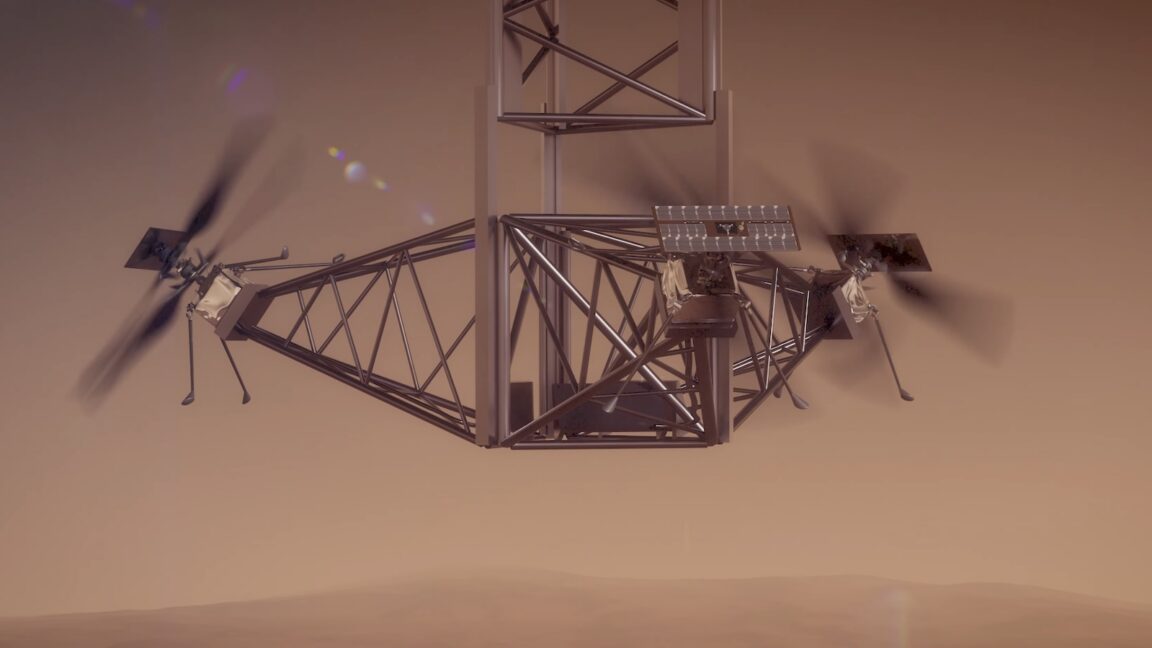
NASA plans to send three advanced helicopters to Mars on the SkyFall mission, which could launch as soon as late 2028. SkyFall will ride to the Red Planet aboard a nuclear-powered spacecraft named Space Reactor-1 (SR-1), one of the tech demonstration initiatives announced earlier this year by NASA Administrator Jared Isaacman. The SR-1 propulsion system will reduce travel time and enable greater payload capacity.
The three SkyFall rotorcraft will be each equipped with the new rotor technology. Their objectives include:
- Surveying potential landing sites for future human missions.
- Collecting high-resolution imagery of geological features in previously inaccessible regions.
- Delivering small science instruments to remote locations for in-situ analysis.
Each helicopter will be capable of flying up to 2 kilometers per sortie, with a total mission range of over 50 kilometers—far exceeding Ingenuity's entire flight distance of about 17 kilometers.
Looking Ahead: A New Era of Aerial Exploration
The rotor technology breakthrough at JPL not only supports the SkyFall mission but also lays the groundwork for even more ambitious designs. Concepts under study include coaxial rotor configurations, quadcopters, and even autonomous swarms that could explore vast areas of Mars simultaneously. These helicopters would operate independently, using AI-powered navigation to avoid obstacles and adapt to changing terrain.
Beyond Mars, the same rotor principles could be applied to exploring the methane-rich atmosphere of Titan, Saturn's largest moon, where denser air makes flight easier. The JPL rotor breakthrough is thus a multiplier for future planetary science missions.
As NASA Administrator Jared Isaacman noted in announcing the SR-1 initiative, "Each step in rotor technology brings us closer to transforming how we explore other worlds." With the new designs, the dream of multi-location sample collection, rapid terrain mapping, and aerial support for human explorers is moving from science fiction toward engineering reality. The sky, even on Mars, is no longer the limit.
— Based on original reporting from JPL and NASA sources.